


Digestion begins before the first bite - and the cephalic phase is where it starts


Most people troubleshooting bloating, reflux, or IBS start by questioning what they’re eating. They cut gluten, trial probiotics, follow a FODMAP plan, keep a food diary. And sometimes that’s exactly the right move. But in clinical practice, there’s something that comes up again and again, something that sits upstream of food choices entirely, and gets missed almost every time.
It’s the conditions in which digestion is actually happening.
Not the food on the plate. The state your body is in when that food arrives.
Where digestion actually starts
Digestion doesn’t begin in the stomach. It begins in the brain.
Before you take a single bite, your body has already started preparing. The sight of food, the smell of it, even the thought of it, these trigger signals from the brain to the digestive system. Saliva starts to flow. Gastric acid begins to release. Digestive enzymes get queued up. Your gut is being primed.
This is called the cephalic phase of digestion. Research estimates that up to 30–40% of your stomach’s acid secretion for a meal is already underway before food arrives. Before you’ve swallowed a thing.
Which means that if those early signals are rushed, distracted, or barely registered, your digestive system is already playing catch-up before the meal has even started.

Digestion is a conversation, not a conveyor belt
The digestive system isn’t a passive tube that food passes through. It’s a coordinated, step-by-step process that depends on signalling between the brain, the nervous system, hormones, and the gut itself.
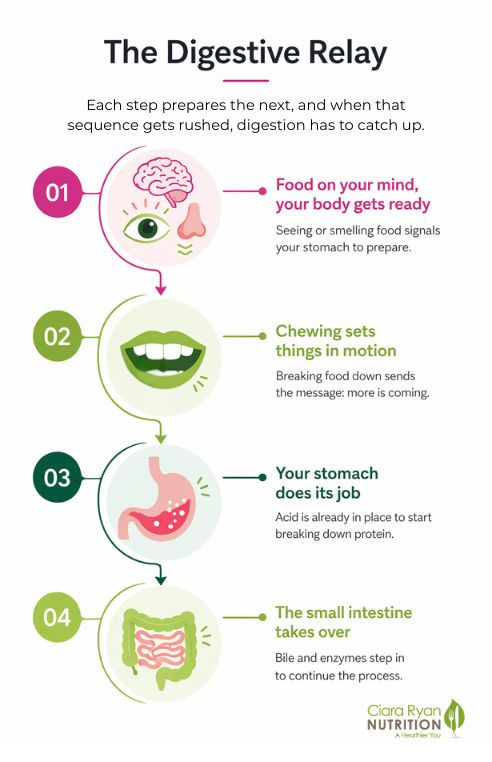
Think of it as a relay. Each stage triggers the next:
Seeing and smelling food prompts the brain to signal your stomach to get ready.
Chewing breaks food down mechanically and sends further signals along the system about what’s coming.
Protein arriving in the stomach needs acid to be there waiting, acid that was already being produced during the cephalic phase.
As food moves into the small intestine, bile and digestive enzymes are released to continue the process.
When those signals are skipped or blunted, which is what happens when you eat quickly, distractedly, or under stress, each stage becomes less efficient. The system has to work harder to catch up. And that’s often when symptoms start to appear.
Feeling uncomfortably full after meals. Bloating or trapped wind. Food sitting heavy in the stomach. Belching. Acid indigestion. Reacting to foods you feel you should tolerate.
Not always. Not in every case. But often enough to be worth paying attention to.
What this actually means day to day
This is where “mindful eating” tends to get an eye-roll, and I’d probably give you one too if someone handed me a leaflet about “being present with your food.” But the physiology underneath it is real, and the practical changes are much simpler than the wellness world makes them sound.
I’ll be honest with clients about this: these are also the things that sound too simple to matter. And they’re often the hardest to actually do, precisely because they ask you to slow down in a day that doesn’t want you to.
Pause before you eat
Even a few seconds. Look at the food in front of you. Take a breath. You’re giving your brain a moment to register that a meal is actually happening, which kicks off that early digestive response.
Sit down
Eating on the go keeps your body in a state of alert rather than a state of digest. The two don’t coexist particularly well.
Chew properly
Chewing is both mechanical and chemical. It reduces the workload further down the system and continues the signalling process. It’s the part everyone knows they should do more of and almost nobody does.
Eat a little less quickly
Not slowly. Just less quickly. Your digestive system needs time to run in sequence, not in a sprint.
Notice how you feel after meals
This is one of the most underused tools going. Patterns here, which meals sit well, which don’t, what was different, often tell you far more than a rigid list of foods to avoid.

Common questions
What is the cephalic phase of digestion?
The cephalic phase is the first stage of digestion, triggered before food enters your stomach. When you see, smell, or even think about food, your brain sends signals that start producing saliva, gastric acid, and digestive enzymes. Your body is preparing to receive a meal before you’ve taken a bite.
Can eating too quickly cause bloating?
Yes, it can be a contributing factor. Eating quickly means the early digestive signals, including gastric acid and enzyme release, don’t have time to fully activate before food arrives. The system plays catch-up, and that inefficiency can show up as bloating, fullness, or discomfort after meals. It’s not the only cause, but it’s one that’s often overlooked.
Does stress affect digestion?
It does. The digestive system works best in a parasympathetic state, what’s sometimes called “rest and digest.” When you’re stressed or eating on the go, your body is in a more alert state, and digestion becomes less of a priority. Signals between the brain and gut become less coordinated, and the process becomes less efficient as a result.
Does it matter where I eat?
More than most people realise. Eating at a desk, in a car, or standing at a counter keeps your nervous system in a state that isn’t particularly conducive to digestion. Sitting down, even briefly, shifts that. It’s a small change that supports the conditions your digestive system actually needs to work well.
The takeaway
Food quality matters. That’s not up for debate. But a nutritious meal eaten quickly, distractedly, standing at the counter or scrolling through a phone, is a meal your digestive system was never fully prepared to receive.
Digestion isn’t just about what you eat. It’s about how well your body is set up to process it. And that process starts, by some margin, before the first bite.
Further reading
If this piece got you thinking, these are worth a read next.
If the food changes haven't fixed it, this explains why that's more common than you'd think.
The instinct when digestion struggles is usually to cut more out. This piece makes the case for the opposite.
Why there's so much conflicting advice about what to eat, and why following it often leaves people further from answers.
We share lots of practical nutrition and lifestyle advice every week in our newsletter. It's written for real people with real lives and is just the kind of thinking that tends to change how people eat and how they feel. Subscribe here and get practical answers instead of more questions.


Comments